
A research-based look at how a compelling cancer story spread online and what critical context got lost along the way.
Last updated: October 22, 2025
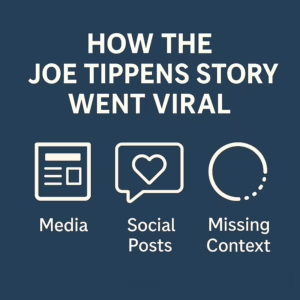 Timeline: how the story spread
Joe Tippens’ story began circulating widely in 2018 after he blogged that he’d used a veterinary dewormer, fenbendazole, alongside standard lung cancer treatment.
Within months, social media groups, podcasts, and health blogs amplified his anecdote as a “cancer cure discovery.”
By 2019, mainstream outlets and YouTube influencers had repeated the claim, often without including critical disclaimers or verifying medical details.
Search interest surged again in 2021 and 2023, driven by renewed social media attention and word-of-mouth promotion in patient communities.
The missing medical context
The viral narrative rarely noted that Tippens received standard medical treatment before or during his fenbendazole use.
Many news and social posts omitted that no peer-reviewed human trial supports fenbendazole as an anticancer therapy.
In reality, clinical evidence remains limited to preclinical research.
Independent reviews, including those from cancer centers, emphasize that self-medication with veterinary drugs carries real risks such as liver injury and treatment interference.
See our evidence summary for details: Fenbendazole & Cancer: Evidence (2025).
Role of media & social platforms
Media outlets that covered the Tippens story often prioritized engagement over verification.
Social platforms then amplified those stories through recommendation algorithms.
Even well-intentioned posts can spread misinformation if key context is missing.
Researchers studying medical misinformation note that repetition builds familiarity, which can be mistaken for truth—a phenomenon known as the “illusory truth effect.”
Once a story gains momentum, correction rarely travels as far as the initial claim.
Lessons for readers
- Check the source: Look for peer-reviewed evidence and disclosures of conflicts of interest.
- Separate anecdote from evidence: A personal story can inspire research but cannot substitute for data.
- Ask your oncology team: Before trying any “viral” remedy, talk with qualified clinicians who know your medical history.
- Use critical reading habits: Verify publication date, author credentials, and whether claims cite studies or just testimonials.
FAQs
Why did the Joe Tippens story gain so much attention?
It offered an emotionally powerful narrative—an apparent success story against cancer using an inexpensive veterinary drug—amplified by social media algorithms that favor engagement.
Did news outlets verify the claims?
Most did not independently verify medical details or the concurrent use of standard therapy. Few included statements from oncologists or peer-reviewed references.
What’s the actual medical evidence?
Only laboratory and animal studies exist. No human clinical trials confirm fenbendazole’s effectiveness against cancer.
How can I fact-check viral medical claims?
Check official medical sites (FDA, NIH, major cancer centers), verify study links, and discuss information with licensed professionals before acting on it.
Overview •
Evidence Review •
Safety & Side Effects •
Legal Guide