Regenerative Organic Agriculture and Mt.Folly 

Industrial farming is at war with nature; we are not. To steward nature’s renewal, we have created a new model for people, work, and the environment. We begin with an organic, regenerative farm—a hub for a rural community—and cultivate purpose-driven companies that grow and radiate outward.” 

At the center of this circular economy is Mt. Folly Farm, where Laura adopted sustainable farming practices as soon as she hit the ground. “I grew up on a farm, rode horses, worked in tobacco, but it wasn’t until after college that I started farming for a living. I thought the farm should be one big organic garden,” Freeman says. Decades later, this remains the dream, though the emphasis has changed, but only a little. 

“I was one of the first to raise and sell beef raised with no antibiotics or growth hormones,” Freeman says. “Years into it, I realized that farming better, then plugging into the industrial food system, did not come close to achieving true sustainability.” 

To address the problem, larger in scope and harder to solve, she first recruited several young people who were local and from the next generation.  The key was that they could imagine a new farm system, uncertain how it would evolve, but certain we would get there.  Then, Laura and the young team went to work. Raising, growing, making, marketing.  

Mt. Folly Hemp  

Our first two retail products were full-spectrum hemp CBD, and products made from our USDA-certified organic CBD. Our full-spectrum CBD is folded into gourmet chocolates made by a nearby 100-year-old candy company.   

Since then, we’ve expanded the hemp product line to include gummies, but our full-spectrum CBD chocolates and caramels are real standouts.  

Our CBD products are sold online and at local retail establishments.   

Mt. Folly Beef and Pork 

Imagine a factory stretched across 50 acres, filled not with machines, but with cattle, pigs, or chickens packed in so tightly they can barely move. Imagine part of the 50 acres is filled with lagoons of untreated manure, more untreated waste than major cities, polluting the air and water, spreading antibiotic-resistant bacteria, decimating surrounding ecosystems. CAFOS aren’t farms. They are industrial waste zones hiding behind “feed the world” rhetoric, at the expense of rural communities, animals, most people and the planet.

At Mt. Folly we don’t buy this, and our customers don’t either.  

Many people just don’t know, however. When you drive around the countryside, you’ll see cows and calves. This is the dispersed part of the system. When the calves are weaned, they are backgrounded, and then most likely sent to an industrial feedlot. 

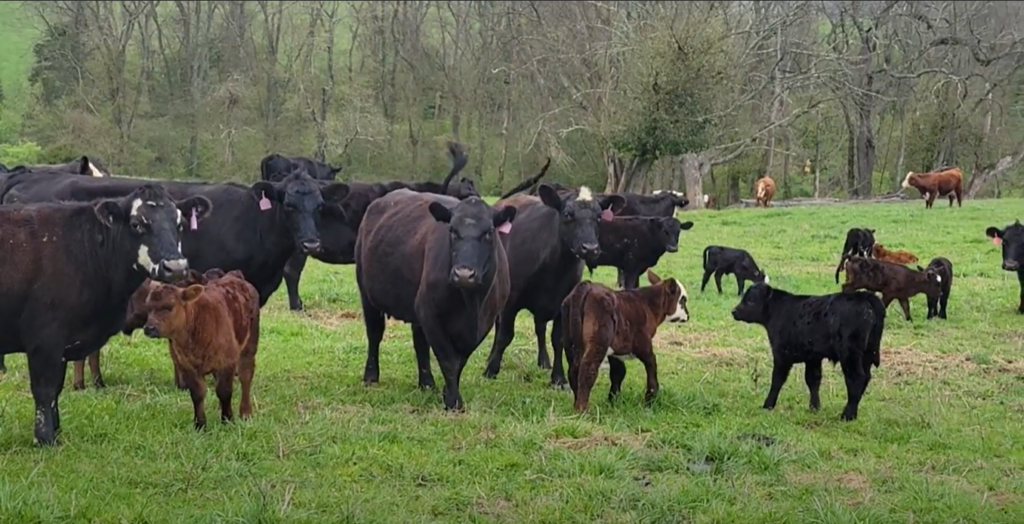
Our cattle are raised and finished on pasture.  Here are Mt. Folly, our cattle don’t leave the farm until they are shipped for harvest, 10 miles away.  

Mt. Folly heritage breed pigs are born and live in the woods, eating corn and mast from walnut, acorn, and hickory trees.  

Our beef is sold at select retailers in Kentucky. 

Our distillery, Regeneration Distillery. 

Kentucky farms have rolling hills, not like flat Kansas or Iowa. Most of the land is suitable for pasture, for horses, cattle, and, in our case, pigs. Our prize fields are reserved for organic crop production – corn, rye, wheat — but what is our retail product?

It’s Kentucky, so whiskey! 

At Mt. Folly, we grow the grain for Boone’s Settlement Wheated Rye Whiskey, Regeneration Bourbon, and we age it in our tobacco barns! The distillery is located in our county seat of Winchester, and our whiskey is sold throughout Kentucky.

The Mercantile on Main 

For locals and visitors, we have a farm store in downtown Winchester. There, you can buy our beef, pork, whiskey, CBD, Chocolates and Caramels. We also carry items from other farm supplies. 

The Moonshine Trail 

Our friends like to get off the beaten path, which is why we founded The Moonshine Trail ® 

This trail takes you from distilleries in Lexington, to Winchester, to Pikeville, with plenty of stops in between.  

Stay at the Homestead Cabin at Mt. Folly 

We do offer a vacation rental on the farm, a 5-star stay that Laura manages. So, come visit! 

Thanks for your support. 

Quick links

Hemp — Grain, Fiber And Cannabidiol

Everyone has heard of hemp at this point, but Mt. Folly Farm has been a leader in the industry since the program was first created. One of the first farms in Kentucky’s Hemp Pilot Program, Mt. Folly Farm has experimented with all 3 types of varieties: grain, fiber, and the most commonly known Cannabidiol (CBD).

Grain and Fiber are planted similar to small grains. Grain requires a combine harvest model; fiber requires a hay harvest model with some adaptions. CBD is the most notable but requires the most effort to be sustainable.

CBD is grown similar to tobacco or vegetable model, mechanical plants, harvest and drying by hand. To make the crop more sustainable, Mt. Folly Farm has experimented with a variety of tactics, no till cultivation, strip till, compost tea, compost, chicken litter for nitrogen, and cover crops before and after the season.

Learn More About Hemp

Cover Crops

Cover crops are essential to any sustainable crop or farm operation. Cover crops are used anytime a crop field is left bare. A cover crop is a plant that is commonly used to sometimes add nitrogen to the soil, prevent soil erosion, improve overall soil health, increase water retention abilities, smother weeds that would otherwise have free reign, and other secondary benefits related to biodiversity.

Mt. Folly uses a wide variety of cover crops; rye is the most commonly used, but we also use tillage radishes to combat soil compaction, and Austrian Winter Peas to add nitrogen before an organic corn crop.

Organic And Non-GMO Row Crops

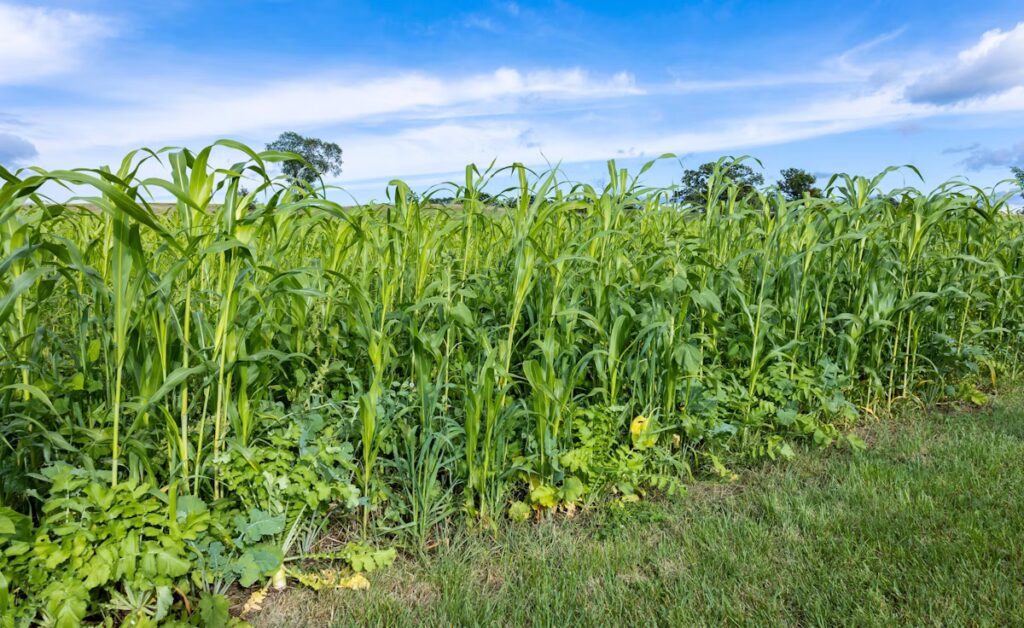
Row crops can include a wide variety of plants. Here at Mt. Folly Farm, we raise corn, soybeans, wheat, rye, buckwheat, sweet potatoes and sunflowers. We are always innovating to improve soil quality and yields while reducing the use of nitrogen inputs by creating and mixing our own compost and manure on site.

The largest obstacle to overcome is weeds. Historically, organic row crops used intensive tillage, plowing and deep discing. However, this disrupts the microorganisms of the soil and requires a tremendous amount of carbon to be expended through operating tractors under strain. This is why Mt. Folly Farm has been implementing low or no till row crops, with experiments with rolled cover crops that act as a mulch bed, and minimum tillage options.

Cattle: Cow Calf Operation

Cattle emit methane, by belching and other means. Better out than in, someone’s Uncle always says. Regardless, this is a source of carbon being emitted at the farm level. The primary way Mt. Folly combats this is to intensively graze and rotate the herds for overall pasture management at an optimal level. This means the grass the cattle are not currently eating, is always growing and capturing carbon.

Cattle: Steers Finished On Grass, Corn, And Distiller’s Mash

Feed lots. Owned and operated by gigantic global corporations have focused solely on profits and have no regard for soil health or animal quality of life. Their only focus is how many animals per acre they can fit and what is the cheapest feed to create the highest rate of gain of the animal’s weight.

On Mt. Folly Farm we focus on no antibiotic, no growth hormone, pastured steers that always have fresh grass available or organic hay paired with a corn ration grown and made by Mt. Folly Farm on site. Most importantly, they sometimes get a treat from our sister company, Wildcat Willy’s Distillery when distiller’s mash is available. The Distiller’s Mash Feed is still high in protein, and a fan favorite of the steers.

Pastured Chickens

Biodiversity on the farm is essential when considering farm sustainability. Chickens not only create diversity, but control insects and spread fertilizer everywhere they go. Mt. Folly built “Chicken Tractors,” which may sound industrial, but is not at all. A Chicken Tractor is really a semi mobile chicken coop that allows you to pasture your chickens in many locations within a field. And with every move of the Chicken Tractor, we spread their fertilizer and insect control.

Forestry Management for Farm Wood Lots

In the simplest definition, trees absorb carbon through photosynthesis to sustain themselves, grow, and sequester carbon. As we are creating a sustainable farm model in the rolling hills of the Bluegrass, Mt. Folly Farm has a full spectrum of soil types, pasture layouts, typography, and wood lots. Mt. Folly Farm keeps wood edges in crop fields, ample shade in cattle pastures, wooded valleys, and one protected forest area at the back of the farm, beyond the old Hornback Bottom, where the oldest family cemetery on the property sits. These wooded areas contain mature trees, soil microbial life only found in wood lots, and a complex and unique fungi ecosystem. Mt. Folly Farm treasures our wooded places and is looking towards stewarding more forest medicinal plants and mushrooms as a way to improve the overall farm finances by protecting these precious habitats.

bio char - terr pretaBiochar

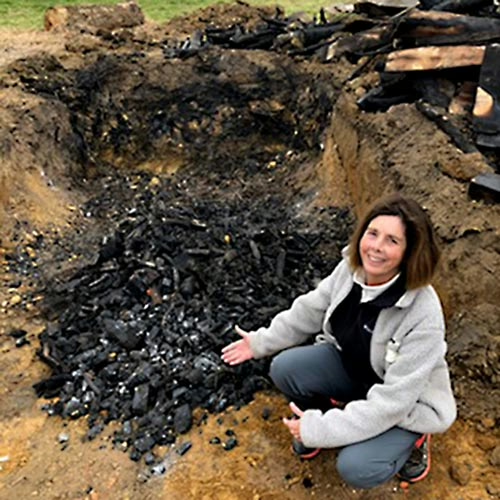
Not all dead trees can be removed, so they rot and decompose back into the soil and create growing opportunities for mushrooms, worms and microorganisms. The ones we can remove get sawed into building materials and any excess gets turned into biochar. Creating biochar has high expectations of mitigating climate change by removing that carbon (wood) from the carbon cycle.

Everyone is familiar with the water cycle, but just like it, carbon cycles through our ecosystem in a similar way. Making biochar is basically the process of making charcoal by igniting wood in a low or no oxygen space for an extended period of time. The end result is a stable form of charcoal or carbon that will not return to participate in the carbon cycle for hundreds, if not thousands, of years.

Compost Tea Sprayer

At Mt. Folly Farm, we mix a compost, de-chlorinated water, molasses and fish emulsion mixture to create a natural amendment of microorganisms that directly and indirectly benefit soil health. This allows plants to increase the efficiency and volume of nitrogen uptake which improves yield.